
12 Questions to Ask Traffic Vendors Before Buying

A traffic vendor can send thousands of visitors and still leave you with no usable leads, no sales conversations, and no clear explanation of where your budget went. That is why the right questions to ask traffic vendors are not about chasing the lowest cost per click. They are about verifying whether the traffic consists of real people who can opt in, engage with your offer, and become buyers over time.
For affiliate marketers, network marketers, and funnel builders, traffic quality affects everything downstream. Bad traffic can distort your conversion data, damage email deliverability, waste follow-up time, and make a decent funnel look broken. Before you buy, get clear answers to the questions below.
Questions to Ask Traffic Vendors Before You Spend
1. Where does the traffic actually come from?
Do not settle for broad answers like “premium sources,” “our network,” or “targeted visitors.” Ask the vendor to explain the source in plain English. Is the traffic generated through email promotions, publisher sites, search, social placements, co-registration, push notifications, or another method?
The source matters because visitor intent changes by channel. Someone who clicks from a relevant email promotion may behave very differently from someone who taps a push notification without reading the offer. A legitimate vendor does not need to reveal every business relationship, but they should be able to describe how visitors are acquired and why those visitors fit your campaign.
2. Is the traffic filtered for bots, data centers, and fraud?
This should be a direct question, not an assumption. Ask what systems or processes the vendor uses to identify non-human activity, repeated clicks, VPNs, proxies, and data-center traffic. Then ask whether they can provide reporting that helps you validate what reaches your funnel.
No traffic source can promise that every visitor will become a lead or buyer. But a serious provider should actively work to reduce invalid traffic rather than treating visitor volume as the only metric that matters. If they cannot explain their filtering practices, your campaign may become their quality-control test.
3. Are these unique visitors, and how is uniqueness measured?
A reported click count is not the same as a count of unique people. Repeated visits from the same person can make a campaign look active while adding little value to your list growth.
Ask whether the vendor measures uniqueness by IP address, device, cookie, or a combination of signals. Also ask about the reporting window. A visitor counted once per day is different from a visitor counted once during an entire campaign. You want to know how often the same person may be sent back to your page.
4. What targeting options are available?
“Targeted traffic” is one of the most overused phrases in the industry. Make the vendor define it. Can you choose geography, device type, niche, interest category, language, or traffic source? Are there exclusions for audiences that clearly do not fit your offer?
More targeting is not automatically better. Very narrow targeting can increase cost and reduce volume, while broad targeting may be appropriate for a low-friction lead magnet. The goal is alignment. Your offer, landing page, and follow-up sequence should match the audience being sent.
5. Can you provide examples of campaigns similar to mine?
A vendor does not need to disclose another client’s private data. They should, however, be able to discuss relevant campaign types and typical expectations. Ask whether they have worked with lead-generation funnels, affiliate offers, business opportunity pages, webinar registrations, or e-commerce offers similar to yours.
Then ask what factors influenced results. A useful answer includes details such as offer fit, landing-page speed, mobile experience, opt-in friction, and follow-up quality. Be cautious with vendors who quote impressive conversion numbers without context. A result without traffic source, offer type, audience, and sample size is not proof.
6. What reporting will I receive during and after the campaign?
You should know what was delivered, when it was delivered, and how the vendor defines delivery. Ask whether reporting includes dates, clicks, unique visitors, geographic breakdowns, source categories, and any filtering applied.
Your own tracking should remain the source of truth for opt-ins, sales, and lead quality. Still, vendor reporting is useful when it gives you enough visibility to compare their delivery with your analytics. If the vendor offers only a screenshot or a vague completion message, that is not enough for a marketer trying to improve ROI.
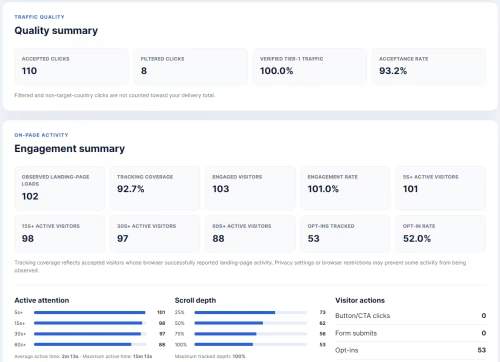
This is what transparent traffic reporting should look like.
See delivery, accepted clicks, visitor locations, engagement, opt-ins, and campaign activity in one report.
7. Can I use my own tracking link or pixel?
The answer should generally be yes, provided your tracking setup does not create technical problems or violate platform rules. Using your own tracking lets you compare delivered traffic against page views, opt-ins, engagement, and downstream conversions.
Ask this before payment, especially if you are testing a new source. You need clean attribution. Without it, you cannot tell whether a poor campaign came from the traffic, the landing page, the offer, or a tracking issue.
8. What is the delivery schedule and volume pace?
Traffic delivered in a sudden burst can produce different results from traffic paced over several days. Ask how quickly the campaign starts, how many visitors are sent per day, and whether delivery can be adjusted if your funnel needs attention.
Pacing matters for more than convenience. A controlled test gives you time to check page speed, form functionality, tracking, and lead quality before a larger volume arrives. If you are building an email list, it also gives your autoresponder and follow-up process a chance to handle new leads properly.
9. What happens if delivery is short or traffic is invalid?
Get the answer in writing. Ask whether the vendor provides replacement traffic, a credit, a refund, or another remedy when the agreed volume is not delivered. Also clarify how disputes are handled and what evidence is needed.
Risk reversal does not mean demanding guaranteed sales. No honest traffic vendor can guarantee that. It means knowing there is a fair process if the vendor fails to deliver what was purchased or if clearly invalid activity appears in the campaign.
10. What conversion expectations are realistic for this offer?
A credible vendor will not promise a fixed opt-in rate or income result. They should help you set realistic expectations based on the traffic type and your funnel. Ask what landing-page format tends to work best, whether mobile traffic is common, and what offer elements usually reduce conversions.
This conversation can reveal a lot. A partner focused on real human traffic will care whether your page loads quickly, communicates a clear benefit, and gives visitors a logical next step. A vendor focused only on clicks will rarely ask about your funnel at all.
11. Can I start with a small test before scaling?
A measured test is usually the smart move, especially with a new vendor. Ask for a test package large enough to produce meaningful data but small enough that a weak result will not drain your budget.
Judge the test by more than cost per visitor. Look at opt-in rate, confirmation rate, email engagement, unsubscribe patterns, sales activity, and whether the leads match the audience you intended to reach. A cheap lead that never opens an email is not necessarily a bargain.
12. Who will help if the campaign needs adjustment?
Some vendors deliver traffic and disappear. Others can help you troubleshoot targeting, pacing, landing-page compatibility, or reporting questions. Ask who your point of contact will be and how quickly you can expect a response.
Done-for-you traffic should reduce complexity, not create a support problem. A responsive provider is especially valuable for newer marketers who need help setting up tracking or for experienced marketers testing a new funnel angle.
How to Evaluate the Answers
You are not looking for a vendor who claims perfection. You are looking for one who answers clearly, sets realistic expectations, and gives you enough transparency to make a sound decision. Vague answers, guaranteed earnings, unexplained “secret sources,” and pressure to buy a large package immediately are all reasons to slow down.
Compare vendors using the same standard. Put each answer beside the actual business outcome you need: more verified visitors, stronger opt-ins, better lead quality, and a clearer path to sales. The provider with the lowest advertised price may not be the one with the lowest cost per qualified lead.
A good traffic purchase begins with a simple test, clean tracking, and a funnel that is ready for real people. Ask direct questions, watch the data after the click, and scale only when the leads prove they are worth acquiring.
Related Topics:
Leave a Reply